Rewilding our Remains
Gifting our bodies back to the place where we began.
Perhaps we can think of this moment in human history as a soulful opportunity to overcome our fears and learn to sit more comfortably with death; to adopt a slow-funeral approach where we take time out of our busy lives, get soil under the fingernails literally and metaphorically, feel the rain and the breeze on our cheeks as we mourn together with others we love.
The most eco-friendly place to have a funeral is in a field, woodland or other wild setting, to allow nature to do what she is renowned for; a soil-to-soil system of recycling the nutrients held within our bodies.
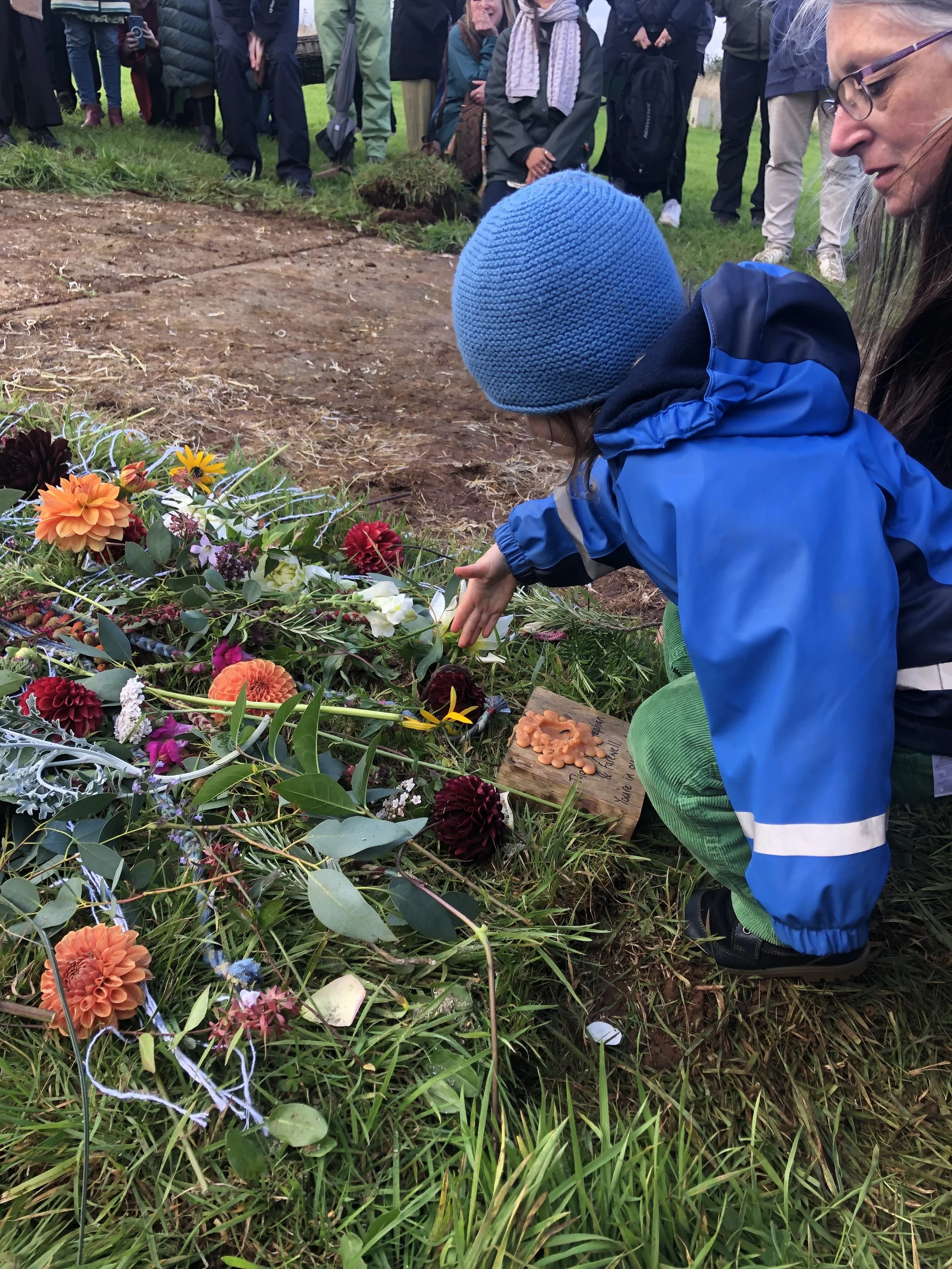
There is nothing to hide or make mysterious if children are encouraged to engage in the funeral process.
In the 2024 series of Springwatch, there is a speeded up film of a dead squirrel (search link below) showing how it is recycled back to earth. A wonderful natural process to watch. No plastic lined coffin or fossil-fuelled fire, no embalming, big-tech or pollution. Just the myriad of creatures in the bed of the forest that gathered and waltzed their way through the corpse, transforming the squirrel into soil, ready to nourish the surrounding trees and vegetation.
When my mother, Primrose, died in 2010 I asked my a friend if I could bury her in his field on Dartmoor, close to my home. He said yes, and the burial was registered with the local authority, as required. Over the years, several more burials happened, and I mused on the feeling that Mum would have enjoyed making friends with these people beneath the grass.
Without planning permission, the number of burials in any given holding, is vaguely restricted to one or two with no mention of the size of the holding. We formed a small core group to explore the process of making this an official natural burial site for the local community, and in 2025 we finally achieved this, the first natural burial site within the Dartmoor National Park boundary.
In the early1990s the visionary manager of Carlisle Cemetery, Ken West, established a nature friendly approach to burial. New graves would be shallower (allowing the richer top soil to break down the body more efficiently), plastic free coffins, no embalming or headstones. Shroud burial was encouraged, firstly because there is better contact with the soil which enhances biological decomposition and secondly because of the reduction of use of wood with all elements 100% natural to allow for total breakdown. This was accompanied by a more regenerative management of the land, reducing mowing and encouraging wild flowers, insects and other wildlife.
It was the birth of the natural burial ground (NBG) movement and there are now well over 300 NBG’s in the UK and numbers are increasing. The UK has become the envy of many countries that have more severe restrictions on burial. You may be reading this living in an urban setting where land is too precious to think about burying bodies, but although there are issues of affordability and availability of natural burial sites, the city of Carlisle has shown this is possible.
An inspiring urban cemetery revival is at Arnos Vale, Bristol, a beautiful and historic cemetery created in 1837 with a vision for a peaceful, nature friendly place which at the time was on the edge of the city. In the 1980’s it fell into disrepair, and having been swallowed up by urban sprawl, was threatened with redevelopment. With the help of Bristol City Council, a small band of volunteers worked to raise money and restore the buildings, monuments and pathways of the 45 acre site, and a section for natural burial was opened in the early 2000’s.
To my mind, this is a beautiful example of local empowerment, galvanised to maintain and regenerate a living, nature-rich space within a city, used by thousands for weddings, funerals, or just walking and connecting with nature.
Given the general acceptance that greening our towns and cities has huge benefits to well-being by improving air quality, increasing nature-connection and biodiversity, what are the options for making natural burial more available to urban dwellers?
In an annual survey of funerals over 60% of the people consulted had concerns about the environmental impacts of disposition of our remains. Despite this up to 80% of funerals in the UK now take place in a crematorium. The predatory nature of corporate selling too often drives families down pathways of compromise as they struggle with grief, vulnerability and sometimes family arguments. The easiest option will mostly point to cremation. Many funeral directors do not even mention the option of natural burial. This may be due to a lack of nearby sites, or just ignorance and a reluctance to step outside the box.
Cremation is calculated as the most polluting of body dispersement methods, despite chimney abatements. Depending on the type of vessel used (normally a coffin), there is also embedded environmental impact relating to the materials source and manufacture, the continued use of plastic handles, glues and linings as well as impact on the environment.
A coffin-free natural burial for a human that closely resembles the simplicity of the squirrel approach, has the lowest impact on the environment, and could also be the cheapest, depending on location and especially if there is ‘light touch’ involvement from a funeral director, or even DIY.
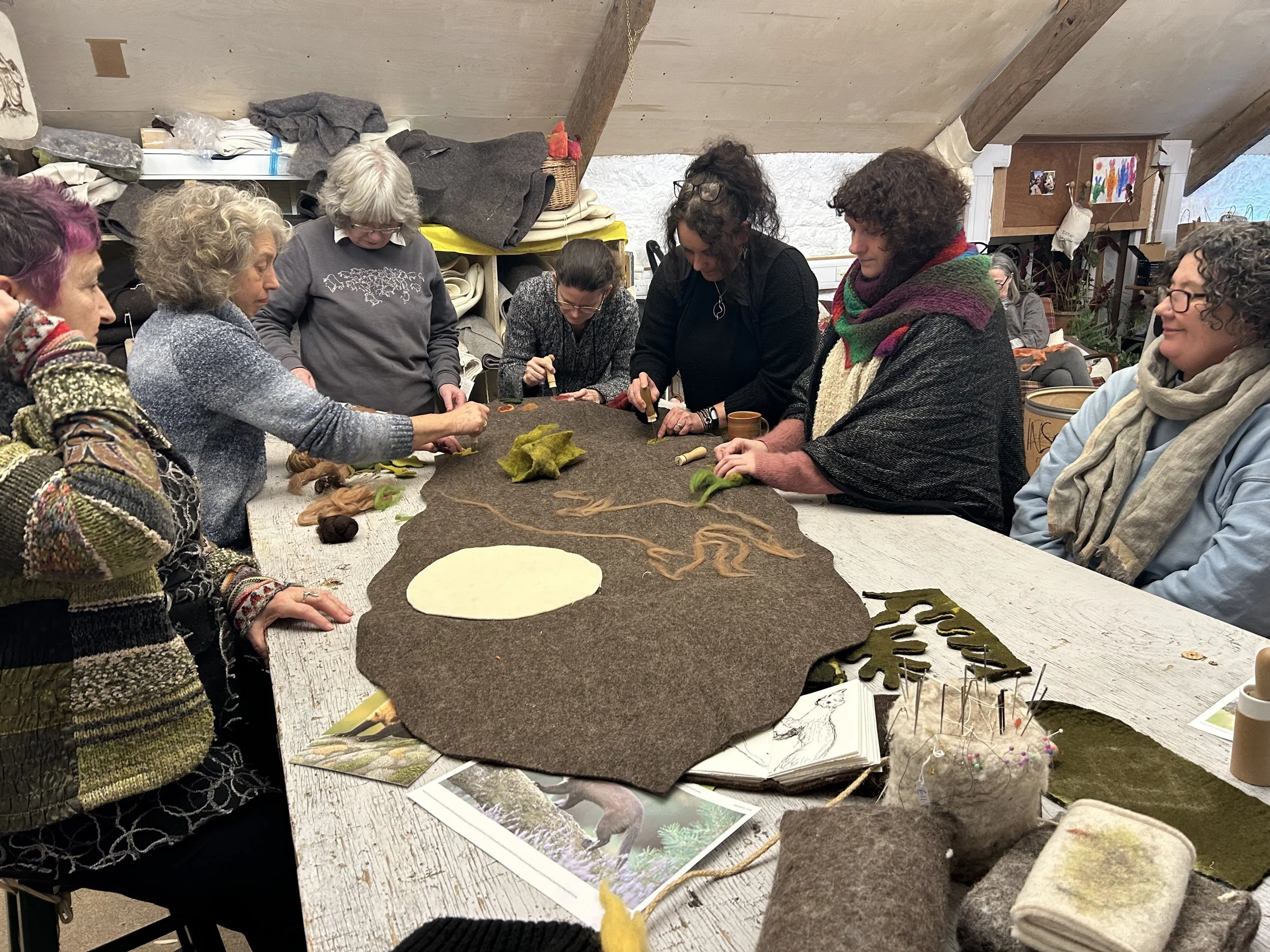
Friends gather to decorate a cover for a Leafcocoon Shroud.
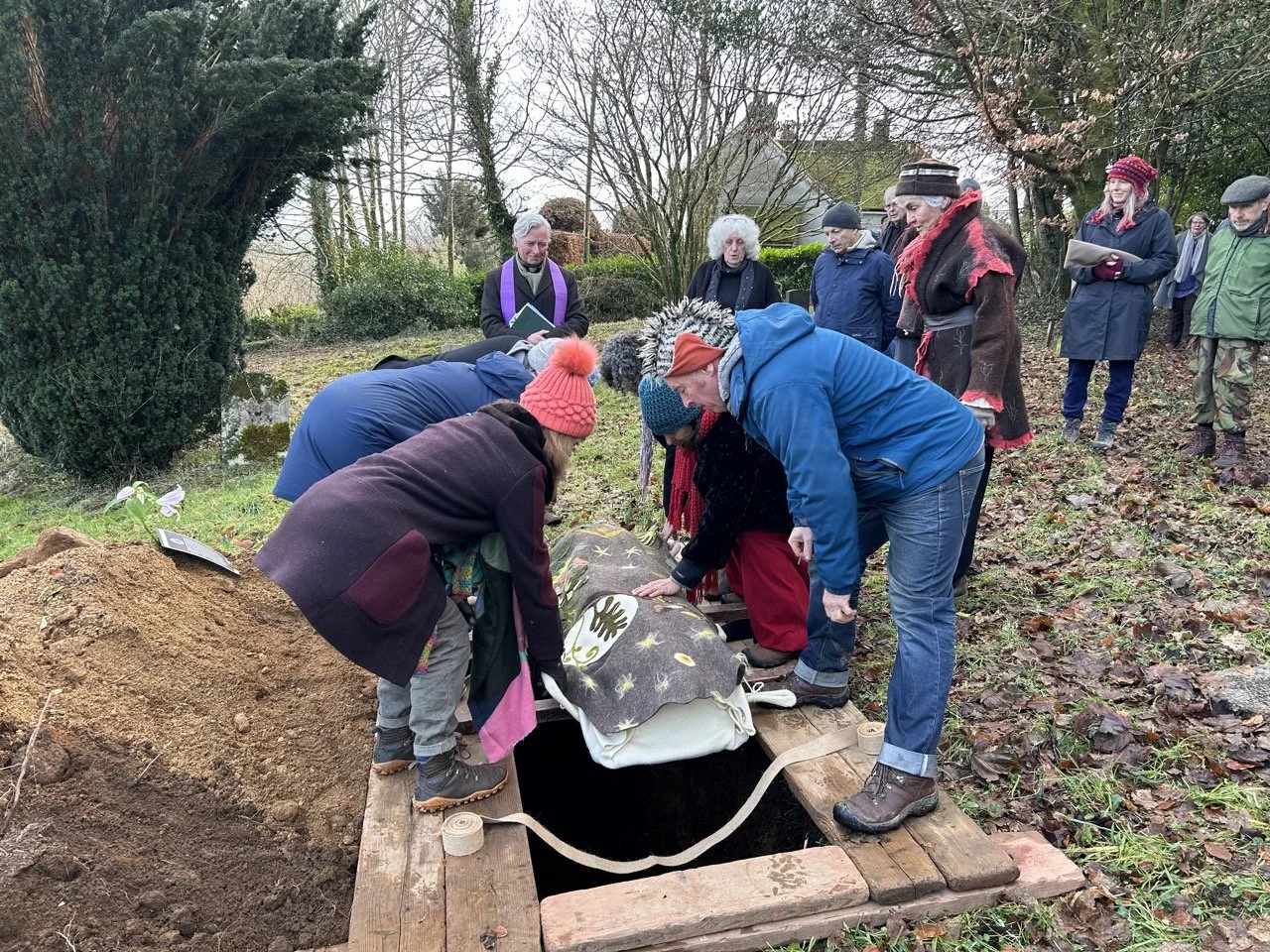
A Community organised funeral
A shroud can be made of 100% natural materials and reduces the amount of wood required to support the body by as much as two thirds.
Our resistance to talking about death rites and culture is understandable and when it comes to burial there is that difficult westernised reluctance to shy away from anything to do with dirt and decay, soil and compost.
If we could feel empowered and enabled to grasp the nettle, learning from nature, we could revisit the ancient ways and invent appropriate practices to be in accordance with a fossil free future. We could at the same time connect to the spirit of the land in a more meaningful and comforting way. Natural burial does not require the import of granite tombstones from across oceans, and although grave sites require management, the ownership of an individual plot becomes less important, increasing a sense of belonging to the wider green surroundings, in a naturally sacred space. I like to think of this as a way of honouring the ancestors beneath us, at the same time as regenerating environment for our descendants.
I am borrowing Rob Hopkins’ question “From What Is, to What If?”
If every parish, borough, district, local and national government authority looked at their 2019 Declarations of Climate and Ecological Emergencies and said:
What if we re-use some of the existing graves in the heart of our communities; the churchyards and cemeteries that are currently deemed closed for burial?
What if other redundant urban spaces are bought by compulsory purchase orders by the authorities, as they are required to provide burial grounds for their citizens? Under their Emergency Declaration imperatives, nature-friendly green spaces within urban areas become important air-cleansing corridors for wildlife and humans needing places to rejuvenate through nature connection.
What if we re-learn to live with our dead within our communities, deepening our respect for the land and the sacredness of life, rather than banning our dead to the commercial centres that profit from our loss?
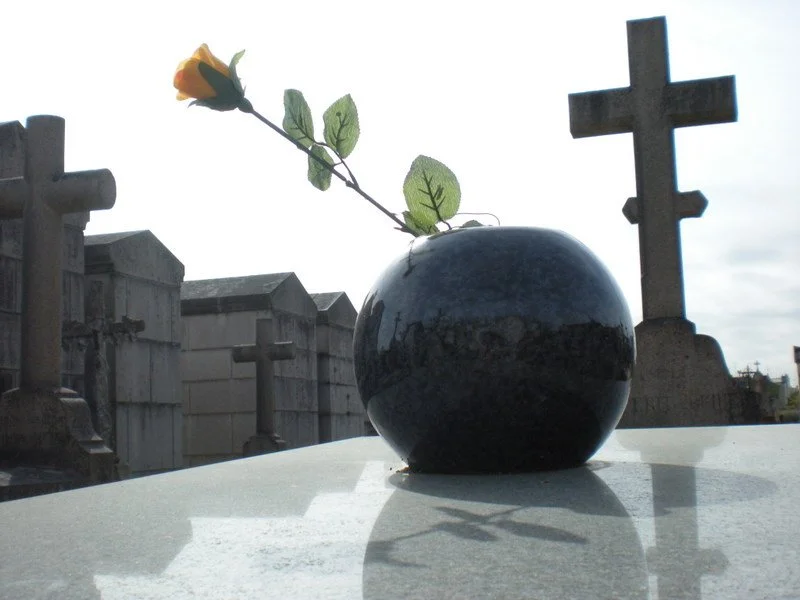
The segregation of our dead to austere cemeteries can feel like banishment - a place to preserve in concrete, denying our natural cycles of nature.
What if just 3% of farms in the UK - that is 6000 holdings - applied for planning permission to bury 100 bodies each year in natural burial settings, there would be no need for cremation, water cremation (resomation), human composting or other technological solutions to the 600,000 (on average) deaths annually in Britain?
In rural areas and on the fringes of urban areas, this is a perfect way for cash-strapped farmers to diversify, without losing productive land, as livestock will still have a use in planned grazing, and farmers could even grow interspersed productive tree crops. Natural burial could even be part of some re-wilding projects in the knowledge that remains will be helping towards the healing and regeneration of a place.
We are lucky in the UK that there are currently relatively few restrictions surrounding funerals. As long as a body is decently clad, you can book a cremation or be buried, wherever you like; you don’t have to use a funeral director, a hearse, or a coffin. You don’t have to abide by companies that impose their own restrictions on what you can or cannot do. You can bury a body in your own garden or land in a shroud as long as this has written permission from the owner if it isn’t yours, and it must be at least 30 meters away from a water course, registered on deeds and recorded with the local registry office.
The developed world has come to such a refined state of development that we have, to a large extent, eliminated a sense of our mortality and acceptance of our natural state. The growth of natural burial perhaps offers us the opportunity to re-invigorate some of the well-worn cultures around death as practised by many religions.
Resources:
What is a Natural Burial?: Association of Natural Burial Grounds (ANBG): http://www.naturaldeath.org.uk/
Springwatch 2024, Episode 6 - 43 mns in. Available on YouTube: youtube.com/watch?v=cpJaw562BYs
Funeral Industry report: https://www.planetmark.com/wp-content/uploads/ 2023/07/Funeral-Industry_PlanetMark_Report-10.07.2023-1.pdf